


Commercial License in Dubai: Eligible Business Activities Explained
If you are planning to start a business in Dubai that involves buying, selling, importing, exporting, or trading goods, a Commercial License is the foundation you cannot ignore. It is one of the most widely used business licenses in the UAE and supports a vast range of commercial activities across industries.
This guide is written to help you fully understand what a commercial license in Dubai is, who needs it, what activities it covers, how it differs from other licenses, and how to choose the right structure for long-term compliance and growth. The language is kept simple and beginner-friendly, whether you are a first-time entrepreneur or an experienced investor entering the UAE market.
What Is a Commercial License in Dubai?
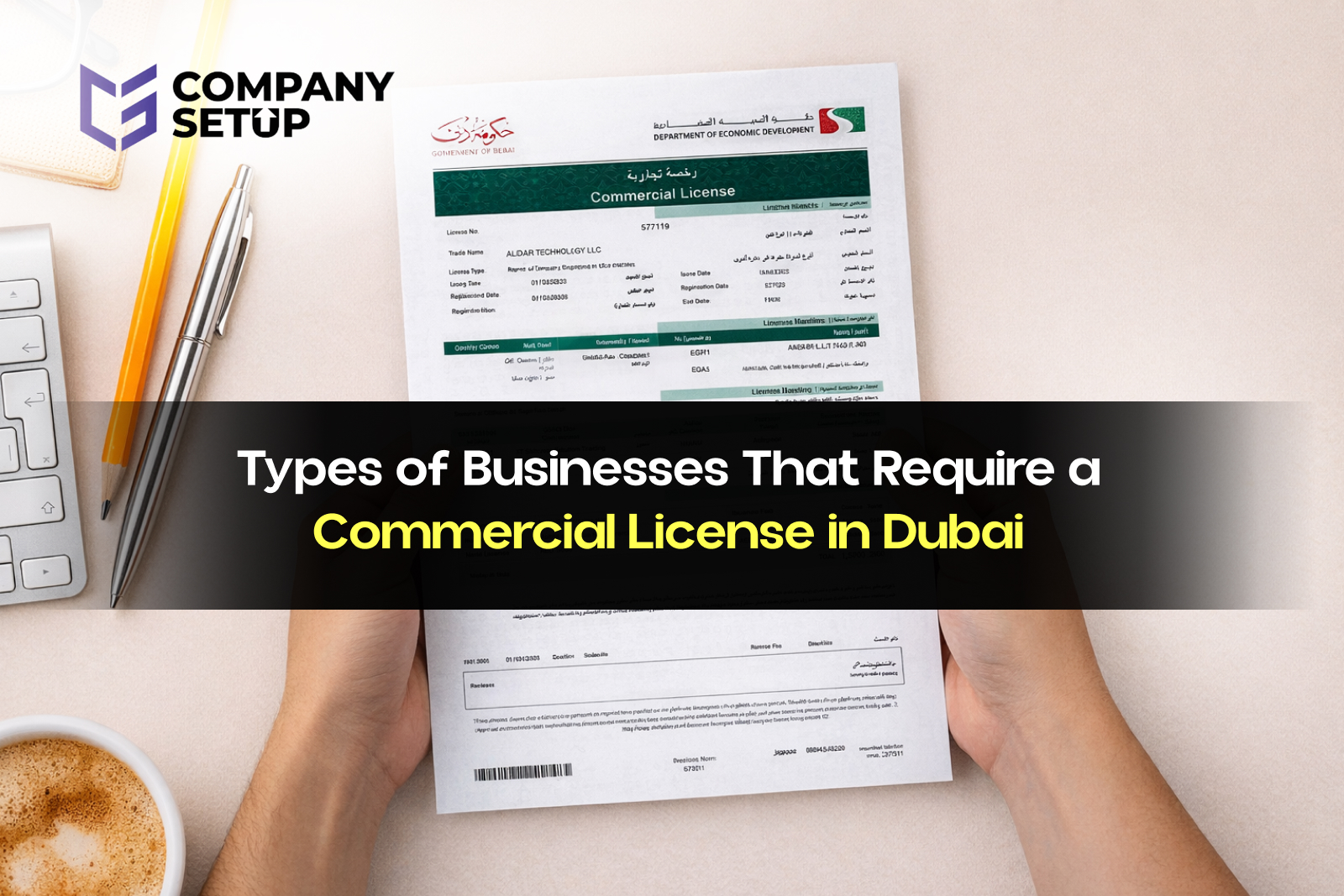
A commercial license is the legal permission required to conduct trading and commercial activities in Dubai. This includes any business that deals with tangible goods or transactional commercial services.
The license is issued by the Department of Economy and Tourism (DET) for mainland businesses and by the respective free zone authorities for free zone entities.
What makes this license particularly attractive is its flexibility. Under a single commercial license, you can list up to 10 related business activities (in many cases), depending on the activity group and approval conditions. This allows entrepreneurs to diversify operations without managing multiple licenses.
Who Needs a Commercial License?
You need a commercial license if your business involves:
- Buying or selling physical goods
- Importing or exporting products
- Running retail or wholesale operations
- Trading through e-commerce platforms
- Conducting real estate transactions
- Providing logistics or transportation services
- Engaging in construction or contracting activities
If money is exchanged for goods or services traded commercially, a commercial license is usually required.
Key Advantages of a Commercial License in Dubai
Before diving into activity categories, it’s important to understand why this license is so popular:
- Ability to trade locally and internationally
- Multiple activities under one license
- Access to the UAE and GCC markets
- Eligibility for corporate bank accounts
- Visa eligibility for owners and staff
- Scalability without restructuring the company
Dubai’s regulatory framework makes it possible to start small and expand gradually without legal friction.
1. General & Specialised Trading Activities
This is the most common and versatile category under a commercial license.
General Trading
A General Trading License allows you to trade multiple unrelated goods under one license. This is ideal for entrepreneurs who want flexibility or operate across multiple product categories.
Examples include:
- Electronics + garments
- Home appliances + accessories
- Office supplies + consumer goods
General trading is popular among import-export businesses, distributors, and wholesalers.
Specialised Trading
If your business focuses on a specific product category, you may opt for specialised trading activities such as:
- Electronics Trading: Mobile phones, laptops, accessories, home appliances
- Fashion & Textile Trading: Ready-made garments, fabrics, footwear, accessories
- Food & Beverage Trading: Foodstuff supply, packaged food, distribution
- Jewellery Trading: Gold, precious metals, diamonds, gemstones
- Automotive Trading: Spare parts, used vehicles, heavy machinery
Specialised trading offers clearer positioning and may involve sector-specific compliance requirements.
2. Retail & Wholesale Businesses
If your business sells goods directly to consumers or other businesses, a commercial license is mandatory.
Retail Activities
Retail covers direct-to-consumer sales, both offline and online.
Examples:
- Supermarkets and grocery stores
- Fashion boutiques
- Electronics stores
- Department stores
Retail businesses can operate through physical shops, kiosks, or digital platforms.
Wholesale Activities
Wholesale businesses focus on bulk supply to retailers, resellers, or institutions.
Examples:
- FMCG distribution
- Industrial supply trading
- B2B product sourcing
Wholesale operations often complement import-export activities.
E-commerce Activities
Selling products through:
- Online stores
- Marketplaces
- Mobile applications
E-commerce businesses still require a commercial license because their transactions involve the sale of goods, even if their operations are fully digital.
3. Real Estate & Property Services (Commercial Scope)
Real estate is often misunderstood when it comes to licensing.
While advisory services may fall under professional licenses, the transactional side of real estate is commercial.
Activities include:
Real Estate Brokerage
- Buying and selling properties on behalf of clients
- Facilitating property transactions
Property Management
- Managing residential or commercial buildings
- Handling maintenance, tenant coordination, and rent collection
Real Estate Leasing
- Leasing or renting self-owned properties
- Managing rental portfolios
These activities require approvals from relevant real estate regulators in addition to the commercial license.
4. Logistics & Transportation Services
Businesses involved in the movement of goods or people typically fall under commercial licensing.
Freight Forwarding
- Land, sea, and air freight coordination
- Import-export logistics management
Logistics & Warehousing
- Storage and distribution services
- Supply chain coordination
Car Rental & Leasing
- Vehicle rental to individuals or businesses
Courier & Delivery Services
- Last-mile delivery
- Postal and express services
Many of these activities also require sector-specific operational approvals.
5. Construction & Contracting Activities
Construction is a major commercial sector in Dubai and requires proper licensing.
General Contracting
- Building construction
- Renovation and maintenance
Specialised Contracting
- Electrical works
- Plumbing services
- HVAC installation
Building Materials Trading
- Cement
- Steel
- Tiles
- Wood and fittings
While engineering design may be professional, execution and material supply are commercial in nature.
Commercial License vs Professional License
This is one of the most common areas of confusion.
Simple Rule of Thumb
- Selling products or executing commercial transactions → Commercial License
- Providing expertise or skill-based services → Professional License
Key Differences Explained
| Feature | Commercial License | Professional License |
| Core Focus | Buying & selling goods | Providing services or expertise |
| Examples | Retail, trading, real estate | Consultancy, IT, law, salons |
| Nature of Work | Transactional | Skill-based |
| Ownership | 100% foreign ownership allowed | 100% foreign ownership |
What If Your Business Does Both?
Some businesses naturally combine services and product sales.
Example:
- A hair salon that also sells its own shampoo line
- A consultancy that sells software or tools
In such cases, you may need:
- A dual license, or
- Specific activity approvals under one license
This ensures full compliance and avoids regulatory issues later.
Mainland vs Free Zone Commercial License
Choosing where to register your business is just as important as choosing the license type.
Mainland Commercial License
- Trade directly anywhere in the UAE
- Work with government and local clients
- Operate physical stores without restrictions
Free Zone Commercial License
- Ideal for import-export and international trade
- Often location-specific operations
- Benefits depend on the chosen free zone
The right choice depends on your target market, business model, and growth plans.
Activities, Approvals & Compliance
Not all commercial activities are equal.
Some require:
- Additional government approvals
- Industry-specific regulators
- External compliance frameworks
Examples include:
- Food trading
- Real estate
- Logistics
- Construction
Choosing the correct activity codes from the start avoids costly amendments later.
How to Choose the Right Commercial License Structure
Before applying, ask yourself:
- What exactly am I selling?
- Will I trade locally, internationally, or both?
- Do I need flexibility for future expansion?
- Will I operate online, offline, or hybrid?
Clear answers lead to a license that supports growth instead of restricting it.
Final Thoughts: Why the Commercial License Matters
A commercial license in Dubai is not just a formality; it defines how your business operates, scales, and stays compliant in Dubai’s competitive market.
With the right activity selection and structure:
- Expansion becomes easier
- Banking is smoother
- Compliance risks are reduced
- Long-term growth is supported
Dubai rewards clarity, preparation, and compliance. A well-structured commercial license is the first step toward building something sustainable in the UAE.
FAQs
Can I have 100% ownership of my trading business on the Mainland?
Yes. Under the updated UAE Commercial Companies Law, foreigners can now own 100% of a Mainland company for most commercial and industrial activities. You no longer need a UAE National as a 51% shareholder for standard trading businesses. However, you may still need a Local Service Agent (LSA) for certain professional activities or specialised sectors, but they do not hold any equity in your company.
What is the difference between a Commercial License and a General Trading License?
- Commercial License: Typically limited to a specific category of goods (e.g., “Ready-made Garments Trading” or “Mobile Phones Trading”). You can add up to 10 related activities.
- General Trading License: This is a “premium” version of a commercial license. It allows you to trade in multiple, unrelated categories (e.g., selling furniture and electronics under one license). It is more expensive but offers maximum flexibility for large-scale importers and exporters.
Can I combine trading and consultancy on the same license?
This is a “mixed” license. Generally, you cannot combine a Commercial activity (selling products) and a Professional activity (providing services) under a single license on the Mainland. However, many Free Zones (like IFZA or DMCC) allow you to mix these activities for an additional fee. If you are on the Mainland, you might need a Dual License or two separate entities.
Do I need a physical office to get a Commercial License?
- Mainland: Usually, yes. You need a physical space with a verified Ejari (tenancy contract). However, the “Dubai Virtual License” and “Instant License” options allow you to operate without a physical office for the first year.
- Free Zone: No physical office is required. You can opt for a Flexi-Desk or “Smart Desk,” which provides a legal address and meets the minimum requirements for license issuance and visa eligibility.
Is an E-commerce License different from a Commercial License?
Technically, E-commerce is an activity within a Commercial License. If you sell physical products through a website or app, you are still “trading.”
- DED Trader License: If you are a UAE/GCC national or a resident selling on social media, this is a low-cost entry point.
- E-commerce Activity: For foreign investors, you simply add “E-commerce” or “Portal” as an activity to your standard Commercial License.
How long does it take to get the license issued?
Dubai has significantly streamlined the process:
- Instant License (Mainland): Can be issued in as little as 5 to 10 minutes through the DET portal (for the first year, without an MoA or Ejari).
- Standard License: Usually takes 3 to 5 working days, depending on how quickly you secure your trade name and office space.
- Free Zone: Timeline varies by zone but typically takes 5 to 10 working days.
What are the tax implications for a commercial license in 2026?
- Corporate Tax: The UAE’s federal corporate tax is 9% on taxable profits exceeding AED 375,000.
- Free Zone Advantage: If your Free Zone company is considered a “Qualifying Free Zone Person” and deals mainly with international trade (re-exports), you may still qualify for a 0% tax rate.
- VAT: You must register for VAT (5%) if your taxable turnover exceeds AED 375,000 annually.
Can I trade across all Emirates with a Free Zone Commercial License?
A Free Zone license is designed for international trade or trading within the Free Zone. To sell goods directly into the “Mainland” (local Dubai market) from a Free Zone, you must:
- Work through a local distributor or agent.
- Open a Mainland branch.
- Obtain a Dual License (available in specific zones like DAFZA or DSO).
Do I need a Commercial License to sell on Amazon or Noon?
Yes. Both Amazon and Noon require you to upload a valid UAE Trade License and VAT registration (once you hit the threshold) to create a seller account. If you are selling physical goods, you need a Commercial License with the specific “E-commerce” or “Trading” activity listed.
Disclaimer: This article is for general information purposes only and does not constitute legal, tax, or professional advice. Commercial licensing rules, ownership options, and tax regulations in the UAE are subject to change and may differ based on your specific business activity, jurisdiction, and profile. Readers should verify requirements with the relevant government authorities or consult a qualified advisor before making decisions.